1. Introduction
The Bay of Bengal is one of the most important marine basins adjacent to the Indo-Pacific region which is distinguished by its unique biodiversity. As a marginal, shallow, funnel-shaped, semi-closed sea, it has immense economic and ecological value. The length of the Bay in Bangladesh along the coast is 710 km with a maximum width of 240 km, along with a surface area of approximately 118813 square km. The average depth is 11 m with an exception of maximum depth of 2000 m (Ahmed 2015).
Over the last few decades, different ministries, departments, and NGOs have conducted several projects on Saint Martin’s Island and its surrounding area. Most of the projects focused on the St. Martin mainland and adjacent areas within 200 meters. No such record was found to search the coral sites in the open sea areas except St. Martin’s coastal water. Based on that, this research was designed to investigate the new coral coverage sites in the Bay of Bengal. This study created a scope to identify the coral coverage sites in the Bay of Bengal and to know the sustainable coral-associated environment and blue economy activity. This will help to balance our healthy coral environment and coral biodiversity. We could create awareness among the people and entrepreneurs.
Many scientists conducted research on corals and coral sites and explored new coral sites around the world. Some research works were done on the corals of St. Martin’s Island, Bangladesh. Among them, renowned Canadian scientist Tomascik (1997) did several dives and reported on the corals of St. Martin’s Island and stated that 100-500 m wide coastline of the island is fringed by a rocky intertidal habitat consisting of small and large boulders and relatively rare coral boulders. The presence of relatively well-preserved dead coral colonies in the upper and middle intertidal zones denotes that the island has been uplifted in relatively recent times. Ahmed (2009) reported 43 species around Saint Martin’s Island. Dr. Rupert Ormond of London University and Dr. Md. M. Maruf Hossain were also involved in the same research work with Ahmed.
Although corals have been identified and studied by various scientists around the globe at different points in time, the investigation of reef corals began with a Danish expedition from 1762 to 1773, during which Forskal gathered corals in the Red Sea (Forskal, 1775; Crossland, 1941). Between 1798 and 1803, while the French Army led by Napoleon Bonaparte was occupying Egypt, Savigny collected and sketched corals (Savigny, 1805-1812), which were later described by Audouin (1828). From 1820 to 1826, Germans Ehrenberg and Hemprich explored the countries surrounding the Red Sea, gathering corals (Ehrenberg, 1834). Around the same period, Rueppel was also collecting in the Red Sea from 1822 to 1827, with some of his specimens being described by Leuckart (1841). The 'BEAGLE,' carrying Darwin, was among the first expedition ships to explore the Indian Ocean when it stopped at Cocos-Keeling and Mauritius in 1836 (Darwin, 1842).
Klunzinger (1879a), who worked at Koseir from 1864 to 1869 and from 1872 to 1874, made a very important contribution to our knowledge of Red Sea corals. Haeckel (1876) visited the Gulf of Suez in 1873 and Ceylon in 1882 (Ortmann, 1889). Many Indian Ocean corals were described by the great systematists of the last century (Milne Edwards and Raime, 1857, 1860; Brook, 1893; Bernard, 1903, 1905; Doederlein, 1902; and Rehberg, 1892). In 1895-96 and 1897-98, two Austrian expeditions on the 'POLA' were made to the Red Sea, whose results for corals were published by Marenzeller (1906a, b). In 1904, Gravier collected in the Bay of Tadjourah in the Gulf of Aden (Gravier 1911). In 1890-91, Ortmann (1892) worked on the African East Coast near Dar-es-Salaam, and Stuhlmann, whose corals were described by Marenzeller (1901), worked in the same area in 1888-89. Corals collected by Simpson and Rudmose-Brown in North Mozambique in 1907-08 were described by Harrison and Pools (1909a). Harrison (1911) also published descriptions of some corals from the Persian Gulf. Voeltzkow (1902) and Fryer (1911) collected on Aldabra, but neither of these collections has ever been completely worked up. The corals from the Natal coast collected by Stephenson were identified by Crossland (1948). In 1874-75, Moebius visited Mauritius and the Seychelles and listed the corals found there (Moebius, 1880). Bourne (1888) collected on the Diego Garcia Atoll of the Chagos Archipelago. In Ceylon (Sri Lanka), collections were made by Ondaatje (Ridley, 1883) and by Herdman in 1902, whose collection consisted predominantly of hexactinellid corals, which were described by Bourne (1905).
Corals were collected from the Mergui Archipelago by Anderson during a visit by the 'INVESTIGATOR' (Duncan, 1889) and in 1907 by Simpson and Rudmose-Brown (Harrison and Poole, 1909b). Forbes was the first to collect corals from Cocos-Keeling Atoll, and this collection was described by Ridley and Quelch (1885). Wood-Jones (1907) again investigated the reefs and corals there, and Vaughan (1918) identified the corals. Wells (1950) investigated and published on the corals collected at Cocos-Keeling by Gibson-Hill in 1941. Bernard (1900) described the corals found by Andrews near Christmas Island. Matthai (1924) studied the coral material held in the Indian Museum, Calcutta, together with specimens from the Arakan coast and extensive collections from the Andamans and Mergui Archipelago, which came mostly from 'INVESTIGATOR' voyages.
Gardiner made the most significant contribution to our understanding of coral reefs and the coral fauna of the Indian Ocean. He led two expeditions; the first, in 1899-1900, went from Minicoy through the Maldives to Addu Atoll (Gardiner 1903-06). cribed (Gardiner, 1904, 1905). The second expedition, the Percy Sladen Trust Expedition of 1905, visited Ceylon, Chagos, Mauritius, Cargados Carajos, Saya de Malha, Coetivy, Farquhar, Providence, Amirantes, Desroches Atoll, and the Seychelles (Gardiner, 1936). In 1908-09, the expedition continued visiting Aldabra, Assumption, Astove, Cosmoledos, and the Seychelles. No complete list of collected corals has ever been published from these expeditions either, but separate groups have been analyzed (Gardiner, 1909; Fryer, 1911; Matthai, 1914, 1928; Horst, 1922, 1926).
Most of the expeditions to the Indian Ocean have been exclusively for oceanographic purposes, but during some of them, dredging brought up deep-water corals. Only seldom have data on corals been published as a whole, as for the 'VALDIVA' deep-sea expedition of 1898-99 (Marenzeller, 1904). The objectives of other expeditions were primarily of a geographic nature, including the description of coral reefs, but they are not considered here unless corals were collected. Twelve years after the publication of Rosen's work (1971a), the commemoration of the 50th anniversary of the 'MABAHISS'/JOHN MURRAY Expedition offers an opportunity to update the synthesis of our knowledge on the distribution of corals in the Indian Ocean, particularly as a number of systematic papers have been published in the meantime. Even in the Proceedings, which contained Rosen's work, some articles were included that Rosen could not have considered. Loya and Slobodkin (1971) produced a table of corals occurring at Eilat, Gulf of Aqaba. Pichon (1971a) published on corals of SW Madagascar (Tulear), NW Madagascar (Nossibe), Reunion, and Mauritius, and Pillai (1971a, b, c) on South Indian Minicoy and the Andamans.
Stehli and Wells (1971) expanded the data of Wells (1954) on the distribution of corals in the Indo-Pacific to include the Atlantic. Data are now available for a further 121 occasions in the Indian Ocean, from which accurate generic numbers can be listed. From 1969 to 1972, the Musée Royal de l'Afrique Centrale at Tervuren and the Université Libre de Bruxelles organized a number of expeditions to the Seychelles, to North Mozambique, and to the Natal coast of South Africa in the region of Durban +9 (Wijsman-Best, Faure, and Pichon, 1980). Boshoff (1981) summed up his 40 years of investigation of the corals of South Mozambique with a checklist. Pichon (1978) reported in a comprehensive work on the results of his studies in SW Madagascar, and Faure (1977) published a checklist of the corals and a very detailed report on the reefs and the corals of the Mascarenes. Pillai and Scheer (1973) and Wijsman-Best, Faure, and Pichon (1980) described the corals of the Seychelles. Publications on Red Sea corals include Wijsman-Best (1977) and Head (1978, 1980) on the reefs near Port Sudan; Bouchon (1980) on reefs at the Jordanian coast of the Gulf of Aqaba; and Mergner (1979) and Mergner and Schuhmacher (1974, 1981) also on the reefs near Aqaba. The Red Sea corals were written by Scheer and Pillai (1983) and summarized the results of a wide variety of collections. In 1957, Scheer collected at several places during the 'XARIFA' Expedition, and near Port Sudan in 1962 during an expedition of the Hessisches Landesmuseum Darmstadt. The comprehensive coral collections of the University of Basel, Bochum, Jerusalem, and Tel Aviv; of the U.S. National Museum of Natural History, Washington; of the Museum for Naturkunde, Berlin; of the Hessisches Landesmuseum, Darmstadt; of the Institute of Oceanography, Port Sudan; and of the Marine Research Laboratory, St. Petersburg (Florida) were evaluated. Further material came from an expedition of the Darmstadt Museum to Eilat and from several diving expeditions of the sports teacher Hollosl in the Northern and Southern Red Sea and the corals collected by Fricke in 1981 with his submersible 'GEO' during several deep-diving projects in the Gulf of Aqaba to depths of 200 m. Rosen (1979) published the checklist of corals from Aldabra collected by the Royal Society Expedition 1968-69. Pillai (1972) published some material from the Laccadives, now called the Lakshadweep Archipelago. Pillai and Scheer (1976) wrote a comprehensive e-paper on the Maldives. During the 'XARIFA' Expedition 1957-58, Scheer was able to assemble a large coral collection from the Addu Atoll in the South to the Miladttmmadulu Atoll in the North. The coral of the Chagos Archipelago was written by Dinsen (1977). Pillai (1971b, 1972) reported on corals from South India and published material on SW Ceylon and the Andamans. The reefs of Ceylon (Sri Lanka) were investigated by Mergner and Scheer (1974), and Scheer and Pillai (1974) dealt with the corals of the Nicobars. Scheer was able to collect corals at the islands of Great Nicobar and Tillanchong for the first time during the 'XARIFA' Expedition, increasing the number of genera known from the Nicobar from 3 to 43.
Ditlev (1976) collected around the islands and coast of Thailand, including Phuket, and in this previously unexplored region discovered a new center of coral development with 65 hermatypic genera and subgenera. Also, during the 'XARIFA' Expedition, Scheer collected in the Strait of Malacca (Pillai and Scheer 1973). Veron, How, Done, Zell, Dodktn, and O'Farrell (1975) added to the data of Telchert (1947) for W, WSW, and SW Australia, and Squires (1966) summarized the information on South Australia from King George Sound in the west to Port Phillip Bay near Melbourne in the east. Zibrowius (1974) showed that, as expected, at the islands of Amsterdam and St. Paul in the south of the Indian Ocean, only a herma-type corals occur, most of which are solitary deep-water forms, and herma-type forms are absent. Jeyabaskaran (2009) newly recorded 20 species from the Lakshadweep Islands.
Although corals are generally valued for their various benefits to human society, functions like coastline protection, variety, and beauty are rarely considered when determining their worth. According to two socioeconomic studies carried out in Florida and Hawaii, reefs increase property values, sales, and revenue. Coastal ecosystems often sustain local economies, and about 40% of the world's population lives within 100 km of a coastline (Cesar et al.2002). Destructive fishing practices and land removal devastate the ecosystem, which in turn diminishes corals' capacity to sustain local economies. This loss in socioeconomic worth reduces the standard of living of society dependent on the coral, and unregulated tourism activities also lead to environmental degradation (Bansal et.al.2025). Sutthacheep et. al. (2019) reported that the total densities of juvenile corals at the study sites were in the range of 0.89–3.73 colonies/m² in the West Gulf of Thailand. Considering the gap and importance of coral and coral coverage site exploration expeditions in the Bay of Bengal, Bangladesh sea territory, this study was designed and conducted.
2. Materials and Methods
Study Area and Expedition Design
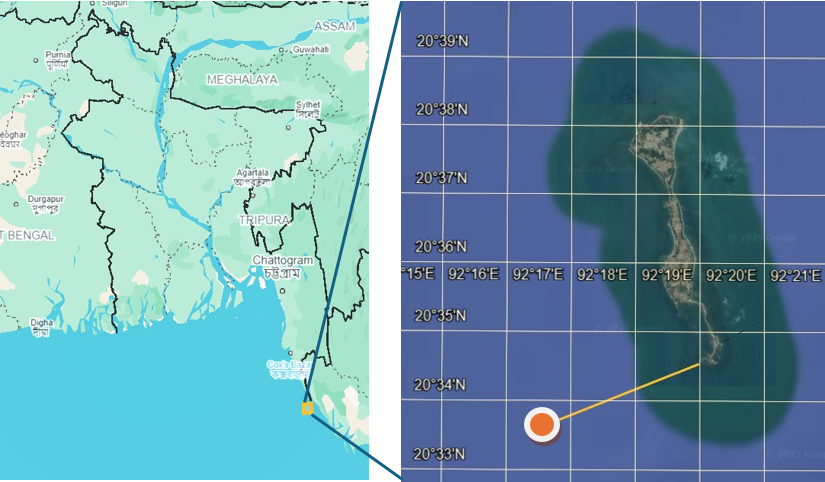
The study focused on an offshore region southwest of Saint Martin’s Island, the only coral-bearing area in Bangladesh. The site was selected based on preliminary bathymetric data and historical fishing reports indicating potential hard-bottom habitats (Fig. 1). Access to these remote locations was facilitated by a mechanized research vessel, which provided stability in open-sea conditions. To ensure systematic exploration, SCUBA diving was employed, with over 8(eight) dives conducted across different tidal phases to account for variability in underwater visibility and current strength. The expedition was strategically timed between November 2023 and March 2024 to avoid monsoon-related rough seas, optimizing safe diving conditions.
Data Collection
Underwater documentation was carried out using a GoPro Hero 9 camera, allowing high-resolution photo and video recording of coral formations and associated fauna. Depth measurements were obtained using a digital depth recorder, while benthic substrate composition (rocky and sandy) was assessed through direct observation and video transects (20 m each). Coral specimens were identified in situ via morphological assessment, focusing on key genera such as Porites (massive boulder corals), Favites (brain corals), Cyphrastea, and Montipora. Environmental parameters, including current intensity and water clarity, were recorded; the latter was measured using a Secchi disk, yielding an average visibility of 91 cm. Site was covered about 0.9km2.
Biodiversity indices analysis: To understand the biodiversity indices, the following methods were used: Shannon Index (H) = -and the Simpson Index (D)method was followed.
In the Shannon index, p is the proportion (n/N) of individuals of one particular species found (n) divided by the total number of individuals found (N), ln is the natural log, Σ is the sum of the calculations, and s is the number of species. The Shannon index is an information statistic index, which means it assumes all species are represented in a sample and that they are randomly sampled.
In the Simpson index, p is the proportion (n/N) of individuals of one particular species found (n) divided by the total number of individuals found (N), Σ is still the sum of the calculations, and s is the number of species. The Simpson index is a dominance index because it gives more weight to common or dominant species. In this case, a few rare species with only a few representatives will not affect the diversity.
Limitations
Field operations faced challenges due to strong surface and bottom SW currents, which reduced dive durations and limited the extent of coral mapping. Additionally, the absence of advanced taxonomic tools (e.g., DNA sequencing) restricted coral identification to genus-level resolution, potentially overlooking cryptic species diversity. Future expeditions would benefit from stabilized underwater drones and genetic sampling to overcome these constraints.
3. Results and Discussion
Open sea exploration and diving always give adventure to explorers. It was very challenging to work during the investigation due to strong surface and bottom currents. The newly explored coral site was enriched with hard corals (Favia sp. and Porites sp.) and coral-associated fisheries. The geographical location of new coral site is 20°03’75’’N, 92°01’58’’E in the southwestern side of St. Martin’s Island in the Bay of Bengal, Bangladesh.
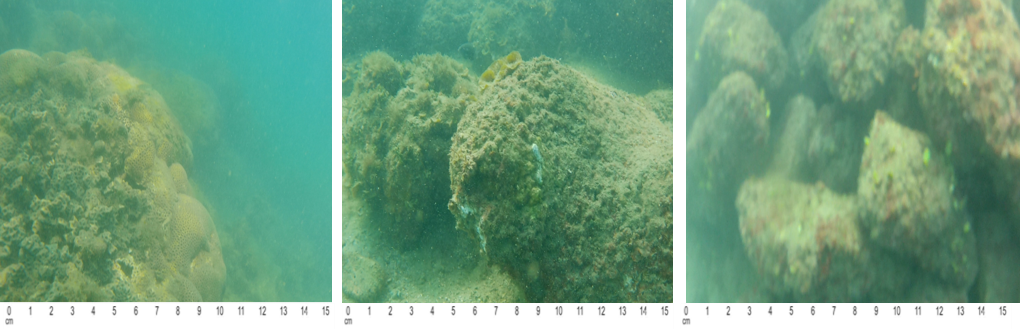
The bottom depth was 9.14 m (Fig. 1), which was 4.5 km away from the main island. The bottom condition was rocky and sandy. A strong SW current was prevailing in the site. Water transparency 91 cm, air temperature 28.50C, water temperature 27.70C, salinity 34 PSU and pH 8.23 were observed. No critical conditioned for coral found in the site. Among the observed species indices, Line transect 2 (Shannon Index (H)=1.551 and Simpson Index (D)=4.723) was more dominant than line Transect 1 (Shannon Index (H)=1.525 and Simpson Index (D)=4.63) were more dominant with species. The coral site was discovered on 31 December 2023. Although Tomscik (1997) and Ahmed (2009) reported the similar species along the coral water within 200 m of St. Martin’s Island. The explored site is within MOEFCC declared MPA. In the investigated time no anthropogenic threats were observed in the site. This new coral site will open our new arena for marine ecosystems, ecological research, and marine tourism, as well as the blue economy.
4. Conclusion
The present study documents the discovery of a previously unexplored coral site approximately 4.5 km southwest of Saint Martin’s Island in the Bay of Bengal, Bangladesh. Field investigations conducted between November 2023 and March 2024 identified hard corals belonging to the genera Porites, Favites, Favia, and other coral groups, together with associated marine fauna. The site, located at an average depth of 9.14 m and covering approximately 0.9 km², is characterized by a rocky and sandy substrate and strong southwestward surface and bottom currents. Underwater observations and transect-based assessments confirmed the presence of coral colonies and associated biodiversity, highlighting the ecological significance of this offshore habitat.
This discovery extends the documented knowledge of coral-bearing habitats beyond the previously investigated nearshore waters of Saint Martin’s Island and demonstrates the importance of systematic exploration of Bangladesh’s offshore marine environment. The newly identified site may provide valuable opportunities for marine biodiversity research, coral habitat monitoring, and the sustainable development of the blue economy. However, further investigations are required to establish the full extent of coral coverage, species composition, ecological condition, and long-term resilience of the site.
Future research should include repeated seasonal surveys, detailed coral taxonomic identification, quantitative assessments of coral cover and associated biodiversity, and monitoring of key environmental parameters. Advanced underwater imaging, remotely operated vehicles, and molecular techniques could improve habitat mapping and species identification. Given the ecological importance of this newly documented site, precautionary conservation measures and appropriate management within the existing marine protected area framework are recommended. Such efforts will help strengthen the scientific basis for coral conservation, sustainable marine resource management, and the protection of Bangladesh’s marine biodiversity in the Bay of Bengal.
Declarations
The author is grateful to the Bangladesh Oceanographic Research Institute for its financial support as well as for facilitating its completion through technical guidance and institutional infrastructure. The author would also like to thank to the researchers for their suggestions, supporting staffs for cordial support during this work.
Author conducted the field study, expedition, data collection, data analysis. Author wrote initial draft of the manuscript and reviewed the manuscript.
Competing interests: The authors declare no competing interests.
Ethics: There is no ethical issue.
Conflict of interest: The authors have no potential conflicts of interest with the research, authorship, and/or publication of the article.
The data that support the findings of this study are available from the corresponding author upon reasonable request.
References
- Coral biodiversity of the Bay of Bengal. MPhil Thesis, Institute of Marine Science, University of Chittagong. 2015:180 pp..
- Explication sommaire des planches de polypes de l'Égypte et de la Syrie, publiées par Jules-César Savigny. Description de l'Égypte. 1828:225–244; 40–58.
- Climate Change and Threat to Coral Reefs of Lakshadweep, Laccadive Sea: An Analysis through a Legal Lens. E3S Web of Conferences. 2025;632:1004. https://doi.org/10.1051/e3sconf/202563201004
- On the Madreporaria collected by Mr. C. W. Andrews at Christmas Island. Proceedings of the Zoological Society of London. 1900;70:119–127.
- The family Porcellanidae. I. The genus Goniopoma. Catalogue of the Madreporarian Corals in the British Museum (Natural History), London. 1903;4:206 pp., 14 pls..
- The family Poritidae. II. The genus Porites. Part I, Porites of the Indo-Pacific region. Catalogue of the Madreporarian Corals in the British Museum (Natural History), London. 1905;5:303 pp., 35 pls..
- An annotated checklist of Southern African Scleractinia. Oceanographic Research Institute, Durban, Investigational Report 49. 1981;49:1–45.
- The atoll of Diego Garcia and the coral formations of the Indian Ocean. Proceedings of the Royal Society of London. 1888;43:440–461.
- Report on the solitary corals collected by Professor Herdman at Ceylon in 1902. Report to the Government of Ceylon on the Pearl Oyster Fisheries of the Gulf of Manaar, Supplementary Report 29. 1905;29:187–242, pls. 1–4.
- The genus Madrepora. Catalogue of the Madreporarian Corals in the British Museum (Natural History), London. 1893;1:212 pp., 35 pls..
- Economic valuation of the coral reefs of Hawai'i. Hawai'i Coral Reef Initiative, University of Hawai'i. 2002
- On Forskal's collection of corals in the Zoological Museum of Copenhagen. Skrifter udgivet af Universitetets Zoologiske Museum Kobenhavn. 1941;1:1–63.
- Reef corals of the South African coast. Annals of the Natal Museum. 1948;11:169–205.
- The Structure and Distribution of Coral Reefs. London. 1842:214 pp..
- The coral fauna of the Chagos Archipelago. Proceedings of Third International Coral Reef Symposium, Miami. 1977:155–161.
- Stony corals (Coelenterata: Scleractinia) from the west coast of Thailand. Phuket Marine Biological Center Research Bulletin. 1976;13:1–14.
- Die Korallengattung Fungla. Abhandlungen der Senckenbergischen Naturforschenden Gesellschaft Frankfurt. 1902;27:1–162.
- On the Madreporaria of the Mergui Archipelago collected for the Trustees of the Indian Museum, Calcutta, by Dr. John Anderson, F.R.S., Superintendent of the Museum. Journal of the Proceedings of the Linnean Society London (Zoology). 1889;21:1–25.
- Beiträge zur physiologischen Kenntnis der Corallentiere im Allgemeinen und besonders des roten Meeres, nebst einem Versuch zur physiologischen Systematik derselben. Physikalische Abhandlungen der Königlichen Akademie der Wissenschaften zu Berlin. 1834:225–380.
- Annotated checklist of corals in the Mascarene Archipelago, Indian Ocean. Atoll Research Bulletin. 1977;203:1–25.
- Descriptions of Animalium (avium, amphibiorum, piscium, insectorum, vermium) quae in itinere orientali observavit. Petrus Forskal / Carsten Niebuhr. 1775;—:164 pp.; Corallia 131–139.
- The structure and formation of Aldabra and neighboring islands—with notes on their flora and fauna. Transactions of the Linnean Society, London (Zoology). 1911;1–4:397–442.
- The fauna and geography of the Maldives and Laccadive Archipelagos. The Fauna and Geography of the Maldives and Laccadive Archipelagos. 1903–1906;1–2:1–471; 473–1079.
- Madreporaria. Pt. I. Introduction with notes on variation. Pt. II. Astraeidae. The Fauna and Geography of the Maldive and Laccadive Archipelagos. 1904;2:755–790.
- Madreporaria. Pt. III. Fungida. Pt. IV. Turbinolidae. The Fauna and Geography of the Maldive and Laccadive Archipelagoes. 1905;2:933–957.
- The madreporarian corals: I. The family Fungiidae, with a revision of its genera and species and an account of their geographical distribution. Transactions of the Linnean Society, London (Zoology). 1909;12:257–290.
- The reefs of the western Indian Ocean. I. Chagos Archipelago; II. The Mascarene Region. Transactions of the Linnean Society, London. 1936;19:393–436*.
- Les récifs de coraux et les madréporaires de la Baie de Tadjourah (Golfe d'Aden). Annales de l'Institut Océanographique, Monaco. 1911;2:1–99.
- Arabische Korallen. Ein Ausflug nach den Korallenbanken des Roten Meeres und ein Blick in das Leben der Korallentiere. Berlin. 1876;—:48 pp..
- Some Madreporaria from the Persian Gulf. Proceedings of the Zoological Society of London. 1911;81:1018–1044.
- Marine fauna from the Kerimba Archipelago, Portuguese East Africa: Madreporaria. Proceedings of the Zoological Society of London. 1909;79:913–917.
- Marine fauna from the Mergui Archipelago, Lower Burma: Madreporaria. Proceedings of the Zoological Society of London. 1909;79:897–912.
- Madreporaria: Agariciidae. Transactions of the Linnean Society, London (Zoology). 1922;18:417–429.
- Madreporaria: Eupsammidae. Transactions of the Linnean Society of London (Zoology). 1926;19:43–53.
- New records of corals from the Lakshadweep Islands. Zoological Survey of India. 2009;109 (Part 1):53–64.
- Die Steinkorallen. I. Abschn.: Madreporaceen und Fulinaceen. Die Korallthiere des Rothen Meeres. 1879;2:88 pp., 10 pls..
- Observationes Zoologicas de Zoophytis Coralliis, speciatim de genera Fungia. Freiburg i. Br.. 1841:61 pp., 4 pls..
- The coral reefs of Eilat (Gulf of Eilat, Red Sea). Symposia of the Zoological Society of London. 1971;28:117–139.
- Ostafrikanische Steinkorallen. Mitteilungen aus dem Naturhistorischen Museum Hamburg. 1901;18:117–134.
- Steinkorallen. Wissenschaftliche Ergebnisse der deutschen Tiefsee-Expedition auf dem Dampfer 'VALDIVIA' 1898–1899. 1904;7:263–318.
- Riffkorallen. Denkschriften der Mathematisch-Naturwissenschaftlichen Klasse der Kaiserlichen Akademie der Wissenschaften, Wien. 1906;80:27–97.
- Tiefseekorallen. Denkschriften der Mathematisch-Naturwissenschaftlichen Klasse der Kaiserlichen Akademie der Wissenschaften, Wien. 1906;80:13–25.
- A revision of the recent colonial Astraeidae possessing distinct corallites. Transactions of the Linnean Society of London (Zoology). 1914;17:1–140.
- Report on the madreporarian corals in the collection of the Indian Museum, Calcutta. Part I. Memoirs of the Indian Museum, Calcutta. 1924;8:1–59.
- A monograph of the recent meandroid Astraeidae. Catalogue of the Madreporarian Corals in the British Museum (Natural History), London. 1928;7:288 pp., 72 pls..
- The physiographic zonation and the ecological conditions of some South Indian and Ceylon coral reefs. Proceedings of the Second International Coral Reef Symposium. 1974;2:3–30.
- Histoire Naturelle des Coralliaires. Paris. 1857;1:633 pp., 10 pls..
- Histoire Naturelle des Coralliaires. Paris. 1860;2:560 pp., 11 pls..
- Eine Reise nach der Insel Mauritius im Jahre 1874–75. Beiträge zur Meeresfauna der Insel Mauritius und der Seychellen. 1880;—:1–65.
- Beobachtungen an Steinkorallen von der Südküste Ceylons. Zoologische Jahrbücher, Abteilung für Systematik, Geographie und Biologie der Thiere. 1889;4:493–590.
- Comparative study of the main features of some coral reefs of Madagascar, La Reunion, and Mauritius. Symposia of the Zoological Society of London. 1971;28:185–216.
- Recherches sur les peuplements à dominance d'anthozoaires dans les récifs coralliens de Tulear (Madagascar). Atoll Research Bulletin. 1978;222:1–447.
- The distribution of corals on a reef at Mandapam (Palk Bay), S. India. Journal of the Marine Biological Association of India. 1971;11:62–72.
- The distribution of shallow water stony corals at Minicoy Atoll in the Indian Ocean with a checklist of species. Atoll Research Bulletin. 1971;141:1–12.
- Composition of the coral fauna of the southeastern coast of India and the Laccadives. Symposia of the Zoological Society of London. 1971;28:301–327.
- Stony corals of the seas around India. Proceedings of the First International Symposium on Corals and Coral Reefs at Mandapam Camp. 1972:191–216.
- On a collection of Scleractinia from the Strait of Malacca. Proceedings of the Second International Coral Reefs Symposium. 1973;1:445–464.
- Report on the stony corals from the Maldives Archipelago. Zoologica. 1976;126:1–83.
- Bericht über eine Korallensammlung von den Seychellen. Zoologische Jahrbücher, Abteilung für Systematik, Ökologie und Geographie der Tiere. 1973;100:451–465.
- Neue und wenig bekannte Korallen. Abhandlungen des Naturwissenschaftlichen Vereins Hamburg. 1892;12:1–50.
- The coral fauna of Ceylon, with descriptions of new species. The Annals and Magazine of Natural History. 1883;11:250–262.
- List of corals collected in the Keeling Islands. A Naturalist's Wanderings in the Eastern Archipelago. 1885:44–47.
- Check the list of recent coral records from Aldabra (Indian Ocean). Atoll Research Bulletin. 1979;233:1–24.
- Ordre des branches d'histoire naturelle et autres, publiés dans la. Description de l'Égypte. 1805–1812;2:pls. 1–14.
- Report on the Scleractinia from the Nicobar Islands. Zoologica. 1974;122:1–75.
- Report on the stony corals from the Red Sea. Zoologica. 1983;133:1–198.
- Diversity and age patterns in hermatypic corals. Systematic Zoology. 1971;20:115–126.
- Contributions to the geology of Houtman's Abrolhos, Western Australia. Proceedings of the Linnean Society of New South Wales. 1947;71:145–196.
- Management Plan for Coral Resources of Narikel Jinjira (St. Martin). Ministry of Environment and Forest, Government of Bangladesh, Final Report. 1997:128 pp..
- Some shoal-water corals from Murray Island (Australia), the Cocos-Keeling Islands, and Fanning Island. Papers of the Department of Marine Biology, Carnegie Institution, Washington. 1918;9 (213):49–234.
- Corals of the Solitary Islands, Central New South Wales. Australian Journal of Marine and Freshwater Research. 1975;25:193–208.
- Die von Aldabra bis jetzt bekannte Flora und Fauna. Abhandlungen der Senckenbergischen Naturforschenden Gesellschaft Frankfurt a.M.. 1902;26:541–565.
- Reef corals from the Cocos-Keeling Atoll. Bulletin of the Raffles Museum Singapore. 1950;22:29–52.
- Recent corals of the Marshall Islands. Geological Survey Professional Paper. 1954;260-1:385–486.
- Indo-Pacific coral species belonging to the subfamily Montastreinae Vaughan and Wells, 1943 (Scleractinia-Coelenterata) Part I. The genera Montastrea and Plesistrea. Zoologische Mededelingen, Rijksmuseum van Natuurlijke Historie te Leiden. 1977;52:81–97.
- Contribution to the knowledge of the stony corals from the Seychelles and Eastern Africa. Revue de Zoologie Africaine. 1980;94:600–627.
- On the growth form and supposed species in corals. Proceedings of the Zoological Society of London. 1907;77:518–556.